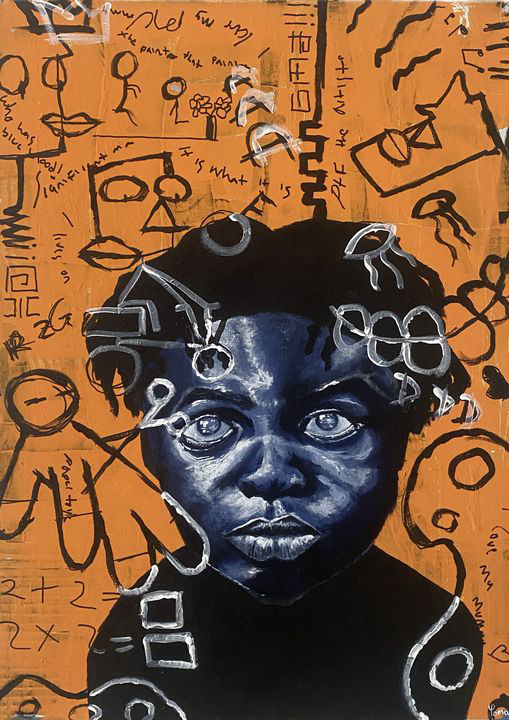
Work “Epigraph” explores writing as a visual and material trace of memory, experience and accumulated time. The work is constructed through multiple layers of handwritten signs, fragmented texts, marks and painterly interventions, creating a surface in which no single layer remains completely dominant. Writing moves between legibility and abstraction, functioning simultaneously as language, image and material gesture. The accumulation of inscriptions suggests a continuous process of recording and rewriting. Earlier marks remain partially visible beneath subsequent layers, creating a palimpsestic structure in which traces are preserved even when they are obscured or overwritten. The surface therefore becomes a space of accumulation, where presence and absence coexist and where the act of erasure never completely removes what has previously been inscribed. The fragmented character of the text reflects the instability of memory itself. Individual signs can be recognized as remnants of language, yet their overlapping and partial disappearance prevent them from forming a singular, linear narrative. Meaning emerges instead through the relationship between fragments, repetitions, interruptions and traces. The title “Epigraph” refers to an inscription placed before or in relation to a larger text, but here the inscription becomes the artwork itself. The work questions what remains when language is detached from its conventional function and transformed into a record of experience. Writing becomes less a vehicle for transmitting a fixed message and more a means of registering thought, memory and the passage of time. Through its layered surface and tension between inscription and erasure, Epigraph examines the relationship between remembering and forgetting. The canvas functions as a kind of archive: every intervention leaves a trace, while every subsequent layer simultaneously conceals and preserves what came before. In this sense, the work presents memory not as a stable repository of information, but as an evolving and fragmented process of accumulation, transformation and loss.
Epigraph
Cikkszám: yng-dg-56
1800,00 EURÁr
ÁFA beleértve
Már csak ennyi van raktáron: 1