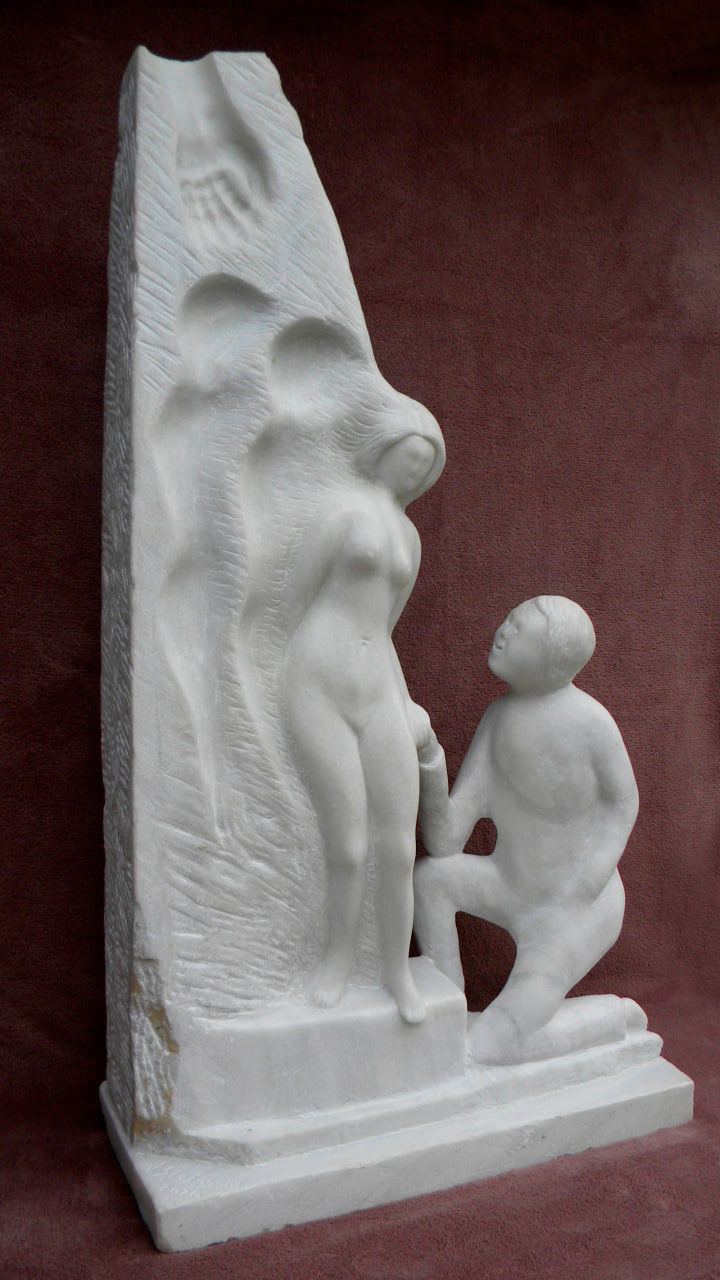
A marble sculpture depicting the moment of metamorphosis, as described by the great poet Ovid, who lived the last years of his life in the port of Tomis (Constanța), Romania, being exiled from Rome in 8 AD and buried about 9 years later in the same locality.
The moral of this sculpture is that eternal beauty is found exclusively in art. It captures the moment of metamorphosis, setting the silhouette of Galatea in motion, abandoning the eternal condition in favor of the perishable.
The free spaces, the meanings of the elements and the centrifugal covering, suggest movement, with the appearance of a supposed disorder that contradicts the static attitude of classicism, while the naked silhouette of Galatea benefits from restrained details that vaguely recall the classical manner.
At the top of the sculpture, in front, is carved the negative sign of the hand of the goddess Aphrodite who gave life to the statue.
The features of Galatea's face are vague, without details. After long hesitations between several variants, the author chooses to sculpt Pygmalion simply, without clothing details, to emphasize the importance of the body position and the facial expression of amazement and wonder in front of the miracle that has taken place. His face is slightly caricatured, expressive, specific to the contemporary style.
PYGMALION & GALATEEA
Cikkszám: IBC-digital-3
6430,00 EURÁr
ÁFA beleértve
Elfogyott