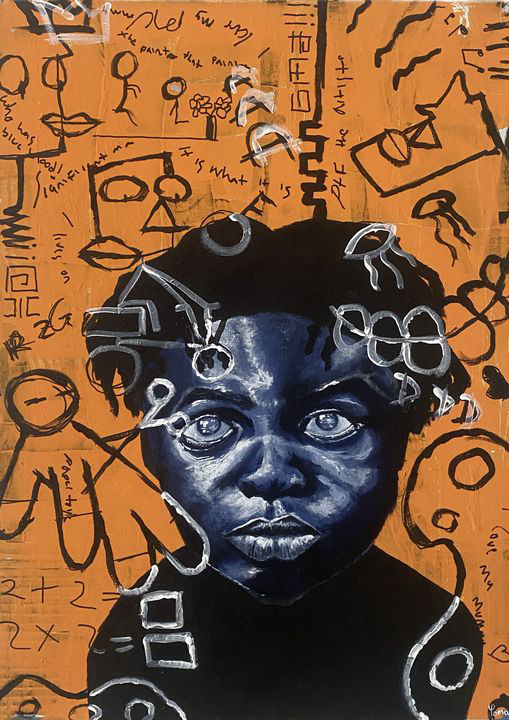
I work with fragments — fragments of emotions, conversations, people, memories, textures, situations, and thoughts that unexpectedly appear in everyday life. Most of my practice begins with observation: the way someone moves, patterns of behavior, emotional states, strange details, objects carrying traces of presence, or feelings that are difficult to explain directly. I am deeply fascinat- ed by human diversity, individuality, and even the quiet strangeness people carry within themselves, but also by objects, spaces, and materials that seem to preserve their own invisible histories. I work across printmaking, graphics, tattooing, illustration, artist books, digital media, and currently explore 3D and real-time visuals. Although these mediums are technically very different, I approach all of them through experimentation, intuition, and unpredictability. I am interested in moments when something emotional, unstable, accidental, or impossible to fully control becomes material. Printmaking remains a lot to my practice because of its tactility and ability to preserve traces, imperfections, textures, and repetitions. The technics allow me to experiment with surfaces, patterns, visual noise, and unexpected reactions within the process itself. At the same time, I carry this same approach into digital practices, illustration, moving visuals, and book-making — treating each medium as a space for transformation, layering, and discovery rather than precision or perfection. A lot of my works are built intuitively. I collect images, thoughts, visual memories, emotional impressions, fragments of conversations, and accidental associations almost like an internal archive, later transforming them into something new. I believe that anything taken out of context has the potential to become something else entirely. I am often interested in searching for meaning even where there may be none — or where meaning constantly shifts depending on who is looking. Sometimes I feel like I construct both my artworks and my thoughts from scattered pieces — and honestly, I wrote this text in the same way. Nature and floral motifs often appear in my works not only as visual elements, but as reflections of interconnectedness, transformation, and shared existence. I am interested in the idea that humans, objects, emotions, and natural forms all carry similar structures, rhythms, and vulnerabilities. For me, nature becomes a space where personal memory, intuition, spirituality, and emotional experience coexist — a reminder that everything around us is part of the same living system. Themes of inclusion naturally exist within my practice through my interest in human diversity, individuality, and the different ways people experience and interpret the world. I am drawn to what feels emotionally, visually, or personally “out of place” — things that do not fully fit into fixed structures, expectations, or clear definitions. I want my works to remain spaces where complexity, sensitivity, contradiction, and different perspectives can exist freely without the pressure to become simplified or fully explained. Rather than offering fixed meanings, I want my works to remain open-ended. One of my favorite questions from viewers is: “What does this work mean?” — because I am often more interested in what they see in it themselves. For me, art is less about delivering answers and more about creating a space where thoughts, emotions, and associations can materialize and coexist.